- This Investor Life
- Posts
- Inside a $100M Art Collection Strategy
Inside a $100M Art Collection Strategy
You don’t have to be a Pinault to Own a Picasso: Interview with a Prominent Art Advisor + Gala Recommendations

This Investor Life
November 03, 2025

The $100 Million Mindset
Building a nine-figure art collection isn't always about having good taste, it's about having better information. The collectors and their advisors operating at this level treat art acquisition like private equity deals: they have thesis-driven strategies, dedicated teams, and exit plans decades in the making.
The Reality Check: At $100M+, you're not just buying art. You are acquiring cultural capital, generational wealth transfer vehicles, and inflation hedges that can appreciate faster than most traditional investments.
(skip to the bottom for the interview and come back to the top for the nitty gritty)
The Infrastructure Behind the Collection
The Team
Art Advisor: $300k-500K annually for acquisition guidance and market intelligence
Conservator: On-call specialist for authentication and preservation (Costs vary especially if restoring automobiles)
Insurance Specialist: Coverage that appreciates with the collection's value
Storage & Logistics: Climate-controlled facilities with museum-grade security OR hire a boutique art advisory firm to handle all of this for you.
Most new collectors budget for acquisition but miss the ongoing expenses:
Insurance: 0.15-5% of collection value annually
Storage: Costs vary for premium facilities and it depends on what kind of art you are collecting (paintings, sculptures, cars, musical instruments)
Conservation: 1-5% of collection value over time
Transportation: $5-50K per piece for international exhibitions
Market Intelligence That Matters
What Drives Value
Museum Acquisitions: When major museums buy a piece, private market prices typically increase 20-60% (depending on what museum, number of pieces available and other factors)
Auction Records: New price ceilings create psychological anchors for future sales
Gallery Representation: Moving from secondary to primary gallery representation signals institutional validation
Cultural Moments: Social movements, anniversaries, and retrospectives create demand spikes
Red Flags to Avoid
Artists whose prices have increased more than 200% in 24 months (bubble territory)
Pieces with unclear provenance or authentication issues
Works that haven't been exhibited publicly in 20+ years
Artists with fewer than 3 major institutional collectors
The Access Economy
At this level, money is necessary but not sufficient. The real game is access:
Private Previews: Seeing major works before they hit public auction
Studio Visits: Direct relationships with living artists for commissioned works
Curator Relationships: Museum professionals who provide market intelligence and validation
Board Positions: Art museum and cultural institution board seats that provide ultimate insider access
The Bottom Line
A $100M art collection isn't an expense—it's a multi-generational wealth strategy sometimes disguised as passion. The families who execute it successfully understand that they're not just buying objects; they're purchasing cultural influence, tax optimization, and legacy building.
The Real ROI: When your great-grandchildren visit "The Family Wing" at a major museum, the return on investment becomes immeasurable.
Want to start building your own collection? Reply to this email and I can connect you to an art advisor or two.
Now for the entrée. This prominent art advisor agreed to speak with me on the condition of anonymity, citing his roster of high-profile clients. In a rare departure from his usual practice of declining all interview requests, he consented to this conversation. Throughout he appears as Mr. A: a pseudonym developed (by me) from his favorite work by an obscure artist.
Elena: Building a $100M art collection sounds like something only a few people in the world can do. Where do you even start?
Mr. A: The starting point is defining purpose. Is the collection primarily an investment vehicle, a legacy for future generations, a philanthropic gesture, or a cultural statement? Once we know that, we can design the collection. With $100M, you can balance blue-chip stability with emerging opportunities. It is not always about buying rare pieces; it’s about scaling a portfolio that tells a story and holds financial resilience.
Elena: What’s the typical allocation strategy at that level?
Mr. A: Roughly 40–60% in “blue-chip” works—Picasso, Basquiat, Warhol, Richter, artists whose markets are established and globally liquid. Then about 15–20% in mid-career artists who have strong institutional support but are still ascending. The remaining goes into emerging artists and experimental categories like digital art (I don’t advise this) or cross-border markets, which can be volatile but sometimes deliver outsized returns.
Elena: How do you balance passion versus investment discipline?
Mr. A: That’s the art of it, pun intended. A $100M collection should be financially sound, but it should also reflect the collector’s vision. If it’s purely transactional, it becomes soulless, something that can be picked up on by other curators and advisors. We often recommend setting aside 10–15% of the budget for “passion buys”—works the collector simply loves, even if they aren’t the strongest investments. Paradoxically, these works often end up being the most cherished and historically significant.
Elena: What role do museums and institutions play?
Mr. A: Significant and the general population largely has no idea. Lending to major museums increases both the visibility and the market value of a work. When your painting hangs in MoMA or the Met, it elevates the piece from “private asset” to “cultural touchstone.” At the $100M level, strategic loans and partnerships with institutions are critical to building provenance and credibility.
Elena: How important is geographic diversification?
Mr. A: Very. Just as in financial markets, you want exposure across regions. U.S. postwar and contemporary, but you also want European/United Kingdom (yes, you can group this) Latin American touch points, and increasingly, Asian contemporary art. A diversified collection hedges against regional market swings and connects the collection to global narratives.
Elena: Do you ever think about liquidity? After all, you can’t just sell a Rothko overnight.
Mr. A: Exactly. Liquidity in art is slower than equities or real estate. But you can create liquidity buffers by holding a portion in high-demand, “market-moving” artists whose works trade frequently at auction. We also structure relationships with auction houses and private dealers in advance, so if liquidity is needed, the path is clear.
Elena: As you may remember, we met at a rare jewel auction at Sotheby’s before Covid, as I was wandering before the auction, I was shocked to discover that there were pieces by Picasso available for under $5,000. What would you recommend to someone in their early career or a family member who may be interested in starting their own collection without allocating millions?
Mr. A: What a wonderful memory from that Sotheby's auction! Those pre-pandemic viewings had such a special feeling, didn't they? And you're absolutely right. discovering accessible pieces among the stratospheric lots are one of those delightful surprises that reminds us art collecting doesn't require millions.
For someone new to the game, I'd offer a few guiding principles:
Start with what genuinely moves you. Whether it's a $500 print or a $5,000 ceramic, if it speaks to you every time you see it, that's your compass.
Consider prints and multiples by established artists. As you discovered, limited edition prints, lithographs, or ceramics by major names like Picasso or Chagall can be remarkably accessible. These aren't "lesser" works—they're often pieces the artist intended for broader audiences. Auction houses regularly feature these in their lower-tier sales.
Look at photography. It's historically been incorrectly priced compared to paintings, meaning extraordinary work by significant photographers often trades well below comparable works.
Attend auctions strategically. Those regional auction houses and online-only sales you encountered can be goldmines. Set a strict budget, do your research on condition and provenance, and don't get caught up in bidding fever.
Elena: Thank you so much for your time today.
Mr. A: It was my pleasure.
Interested in the links to auction houses where you can score a major artist’s works for $5k and under?
Message me and I would be happy to send them to you.
Gala Season is Upon US!
Giphy
A few recommendations to consider:
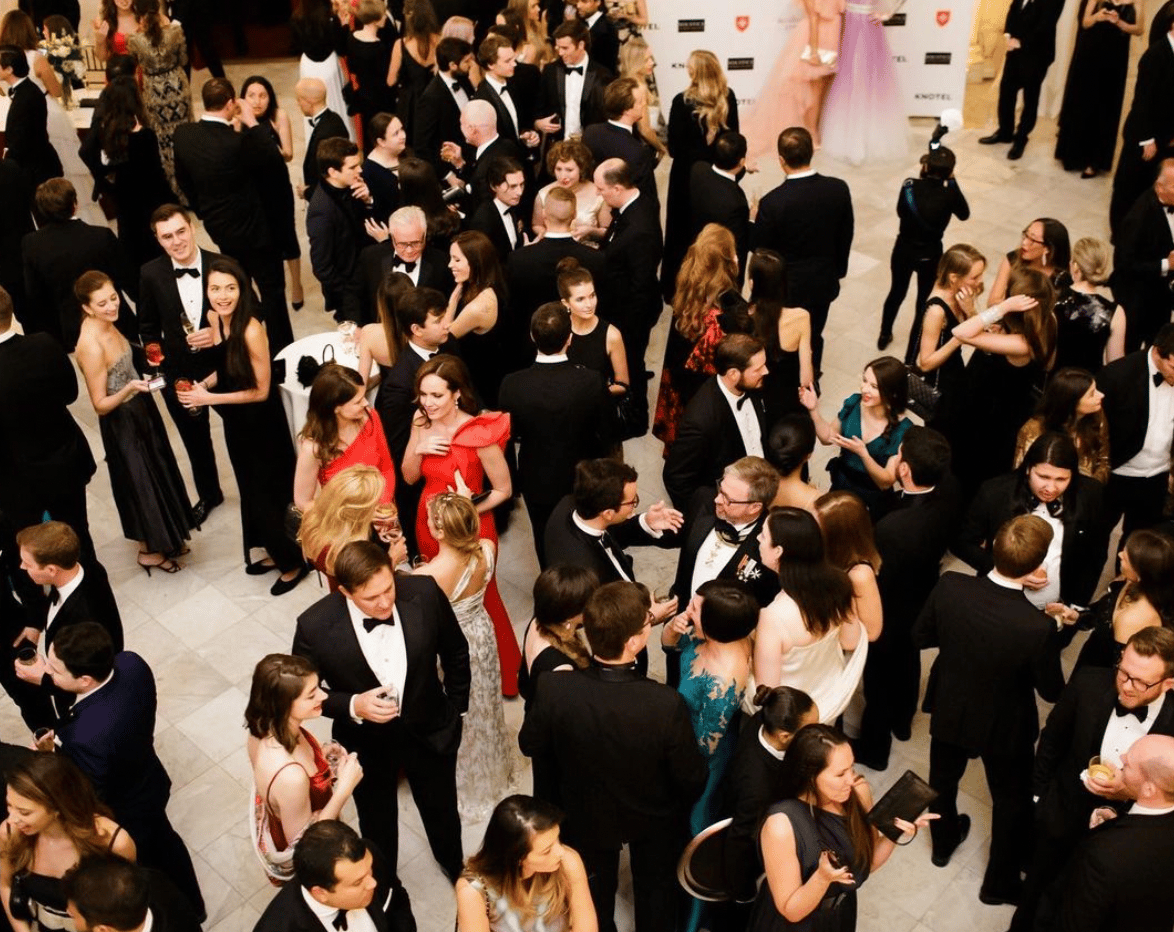
White Cross Ball (pictured above from 2023)
Fri, Nov 7, 2025
The White Cross Ball of New York City raises money to support three of the Order of Malta's international humanitarian works: The Holy Family Hospital of Bethlehem Foundation; Malteser International, Order of Malta Worldwide Relief; and The Order of Malta's summer camps for disabled youth.
By Invitation Only (ask me and I know a couple people looking for a +1)
Dress Code: Black Tie, Miniatures
Location: The Metropolitan Club, 1 East 60th St, New York, NY 10022
More Information: https://www.stjohncommittee.org/wcb
New York Scottish Ball
Sat, Nov 15, 2025
Benefiting The New York Caledonian Club, which creates and facilitates opportunities for friendly social events and educational workshops in order to maintain and strengthen connections with Scotland and Scottish diaspora communities around the world.
Dress Code: Highland Dress or Black Tie
Location: Down Town Association, 60 Pine St, New York, NY 10005
More Information: https://www.nyscottishball.com/
Waltz Series Dinner Dance
Fri, Dec 5, 2025
The Waltz Series is a social club of people who love to dance – especially the Viennese waltz. On four evenings each year, members and guests gather to enjoy dinner and dancing to live music. Members dress in formal attire – the gentlemen in white tie and tails, the ladies in long gowns – to enhance the pleasure of the waltzes. According to custom, seating is by couples, and each gentleman dances a minimum of one time with each lady at his table. Table-hopping is traditional. The Paul Jones mixer helps to create a relaxed, convivial atmosphere.
Dress Code: White Tie
Location: The Cosmopolitan Club, 122 East 66th St, New York, NY 10065
More Information: http://thewaltzseries.org/
65th Quadrille Ball
Sat, Feb 7, 2026
The Quadrille is dedicated to promoting Trans-Atlantic friendship and understanding by raising funds to benefit the German-American Scholarship Association for the exchange of American and German graduate and undergraduate students.
Dress Code: White Tie
Location: The Plaza Hotel, 768 Fifth Ave, New York, NY 10019
More Information: https://quadrilleball.org/
More global balls to be shared in the next edition (stay tuned)
Ciao,
Elena
p.s. love hearing from you, please send your questions & stories on how This Investor Life has helped you ([email protected])